Methodology
The methodology is loosely based against the backdrop of the various stages a developer and/or consultant would be required to take when assessing cause-effect as part of an application for consent for a port related operation or development. Based on the information input to the system, it is designed to make an assessment of the potential changes that could result from the proposed operation or development, together with the Natura 2000 features sensitive to those changes. As such, it is not an indicator of impact or significance, merely a method to identify the potential issues that may require further investigation. The various methods that would be appropriate for assessing impact and the significance of that impact are then highlighted.
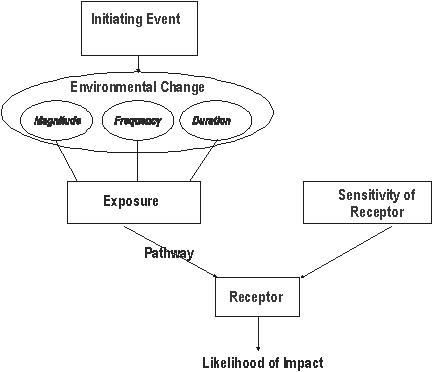
The basis of the method is one used to assess impact during Environmental Impact Assessment or Appropriate Assessment, since the issues to consider are similar. The impact assessment process used is summarised below:
Data Input to the Method
Essentially, the method requires the following information to be identified by the user:
- Initiating event – what activities are associated with the port development or operation? Activities may include dredging, piling, shipping movements etc.
- Receptor – what Natura 2000 features are present in the area, both in sites in which the development/operation falls and in the near vicinity.
Information that is contained within the method includes the following:
- Environmental change – the types of environmental change that can result from each activity, e.g. dredging can lead to increases suspended sediment and vessel movement can cause disturbance.
- Sensitivity – the potential for the Natura 2000 features to be sensitive to each of the changes that may result from the activities selected, for example birds can be sensitive to disturbance from vessels and some fish can be affected by increased suspended sediment.
Therefore, when the activities and features have been selected, the methodology automatically selects the appropriate environmental changes the Natura 2000 features are sensitive to. It is important to note here that sensitivity does not equate to impact, merely the potential for impact. For an impact to occur, a pathway or linkage between the change and the feature is required – if the environmental change does not reach the feature, then no impact can occur.
Feature ‘Attributes’
When considering the sensitivity of the receptors, the approach taken considers various aspects or ‘attributes’ of the feature that can be affected, which have been based on UK conservation objectives for Nature 2000 features i.e. around the aspects of the feature against which change is measured. These attributes differ for habitats and species and are given as follows:
Species
- Extent of supporting habitat for Natura 2000 species;
- Natural range and extent and species;
- Distribution of the species (including patchiness/continuity of species;
- Population dynamics – productivity, size and structure.
Habitats
- Habitat range and extent;
- Vegetation structure within the habitat;
- Physical characteristics of the habitat;
- Distribution of biotopes (including patchiness/continuity of biotopes;
- Successional change of constituent biotopes or individual features;
- Range and diversity of constituent biotopes within the habitat.
It is the sensitivity of the attributes of the features that will require assessing, as these represent the way in which change is measured – e.g. does the environmental change have potential to affect the vegetation structure within a given habitat feature.
Initial Outputs
The initial stages of the method enable the user to select the activities they are interested in and the Nature 2000 features of relevance, with the first stage in the method process being the identification of which environmental changes have the potential to affect which attributes of the features. At this stage, no differentiation is made for the scale of the activity, the proximity to the receptor or whether a pathway exists to link the change and the feature together. It is purely a tool for identifying the potential for changes to occur and as such is a ‘catch all’ returning fairly detailed lists of potential cause-effect linkages. The potential for a given activity to lead to such linkages will always be site and activity specific, requiring site specific study. What the method does provide here is a standardised approach to determining the cause-effect links, which is transparent and therefore auditable.
Methods for Assessing Cause-Effect
Included in the methodology is a list of methods for assessing cause effect. These include methods such as modelling, GIS techniques and use of impact assessment tables/expert judgement. They range from generic methods, that can be applied to a wide variety of issues, to some very specific methods that have been devised to assess particular cause-effect linkages.
In order to select the appropriate methods for each cause-effect link, a 3 stage approach was used, looking at methods suitable for the environmental change, the feature/feature attributes sensitive to that change. The reasoning behind the approach is that a method may be ideal to assess a change in hydrodynamics, but not the affect of that change on saltmarsh extent. Therefore, for the methods selected to be relevant to Natura 2000, the following three criteria need to be met:
- Is the method appropriate to assessing the particular environmental change?
- Is the method appropriate to assessing effects on the particular Natura 2000 feature?
- Is the method appropriate to assessing effects on the relevant feature attribute?
The methodology then selects the methods that can be used in each situation, to assess the cause effect linkage from environmental change to feature attribute.
Refining the Method List
As no information on the scale of the proposed port operation or development has been entered, nor information on the relative sensitivity of the feature or the potential profile of the proposal has been entered, the list of potential methods returned as being appropriate for the particular cause-effect linkage are long and tend to range from qualitative methods such as expert judgment through to large scale and costly (in both time and monetary terms) methods. In the first instance, a lengthy list does not help the user in selecting the most appropriate method and secondly, the selection of method should take consideration of several other factors such as the scale/value of the proposal, relative sensitivity of the environment, timescale/data restrictions etc. For example, it may not be appropriate to require extensive data collection and modelling to assess the impact from the installation of 3 piles, similarly expert judgment may be insufficient for a large scale capital dredge.
Therefore, to refine the list of possible methods, a number of pieces of information have been selected, to direct the choice of methods to those that may be more appropriate. To do so, 3 main areas have been considered:
- Input on the operation or development activities – indicators of their scale, duration etc;
- Input on the particular Natura 2000 features present – are they a priority species/habitat, what is their range in the site/member state/region and what is their condition;
- External factors – are the features of particular interest/concern to the public and are there any particularly significant issues that may be raised by the regulators.
Use of the above information enables the targeting the identification of methods to the more appropriate range.
Proposed Additions to the Methodology
As it currently stands, the methodology provides a great deal
of information that is separated into numerous ‘strands’,
in that it is currently necessary to investigate each cause-effect
linkage to obtain possible methods. Therefore, it is proposed to
group the outputs from the methodology much more. For example,
at present, the same environmental changes may be caused by a variety
of activities – e.g. an increase in suspended solids can
be caused by dredging, construction etc. The next stage in the
process of designing the website will be to group the outputs,
providing a more user friendly output that summarises the appropriate
cause effect methods for all the activities/features.
